

Hyundai i10 Automatic Review for Your Icelandic Adventure
Thinking about renting a Hyundai i10 automatic for your Iceland trip? Here's an honest look at what it's really like to drive, from Reykjavík streets to long stretches of the Ring Road.
Quick Verdict
Short on time? Here's the answer before we get into the details.
The Hyundai i10 Automatic is one of the smartest budget picks for Iceland if you're traveling alone or as a couple and sticking to paved roads. It's cheap on gas, easy to park, and simple to drive since it shifts gears for you. What it won't do is take you off the beaten path. It only drives the front wheels, sits low to the ground, and has no business anywhere near an F-road.
I'd give it 4 out of 5 for a summer road trip on Iceland's main routes, and closer to 3 out of 5 once winter weather gets involved. It works best for one or two people doing Reykjavík, the Golden Circle, the South Coast, or a relaxed summer Ring Road loop. It's not the car for four adults with full suitcases, and it's definitely not the car for the Highlands.
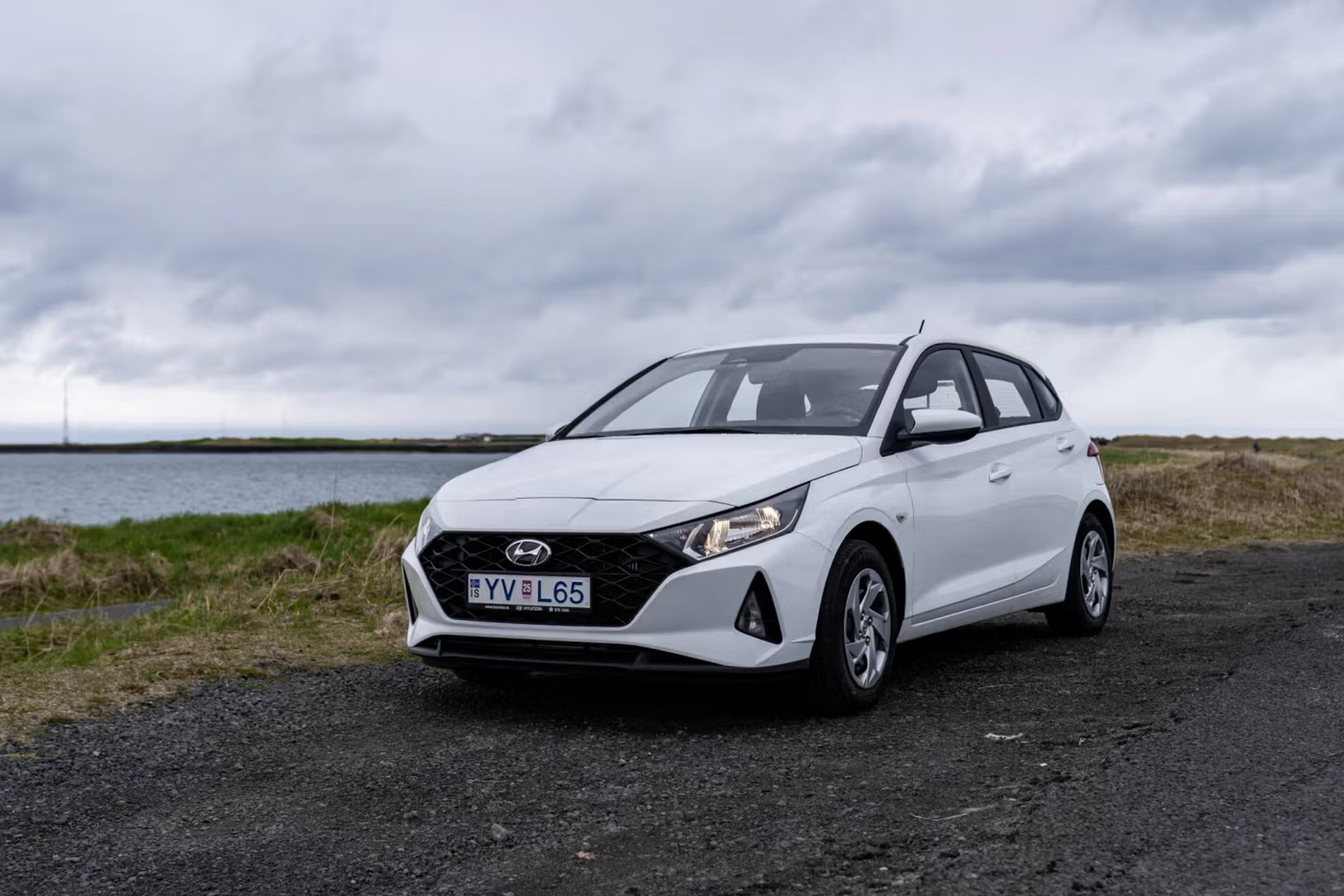
Car Overview
Before we get into how it drives, let's cover what you're actually renting.
The i10 is Hyundai's smallest car in Europe, a five-door hatchback that's just 3.67 meters long. Small as it is, it seats five people and still has a real trunk, which is more than you can say for some of its rivals.
Basic Specs
Here's what you're working with on a typical 2023-2025 automatic rental car.
- Body: 5-door hatchback, small city car
- Seats: usually 5
- Transmission: 5-speed AMT (more on this below; it's not the same as a normal automatic)
- Fuel: petrol
- Drive: front-wheel drive only, no AWD or 4WD option
- Ground clearance: around 149 mm
- Trunk: 252 liters, or 1,050 liters with the back seats folded down
- Fuel tank: 36 liters
What "Automatic" Actually Means Here
This part confuses a lot of renters, so let's clear it up.
Most automatic i10s from this period use something called an AMT, short for Automated Manual Transmission. Underneath, it's basically a manual gearbox, but the car handles the clutch and gear changes for you instead of you doing it yourself. There's no clutch pedal, so you drive it just like an automatic. The main thing you'll notice is that gear changes can feel a bit more noticeable or slower than in a regular automatic, especially going uphill. That's just how this type of gearbox works, not a sign that something's broken. My advice: ease off the gas a little when you feel it shifting instead of flooring it through the change.
Passenger Space and Comfort
Small on the outside doesn't mean cramped inside, and that's actually one of this car's best qualities.
Here's roughly how it handles different group sizes:
- 1-2 adults: plenty of room front and back
- 3 adults: still works fine
- 4 adults: the seats can handle it, but your bags might not
- 5 adults: legal, but not something I'd recommend for a multi-day Iceland trip
For a couple doing an eight-hour driving day, the cabin holds up well. You'll hear more road and wind noise than in a bigger car, and rougher roads will make themselves felt a bit more, but it's far from uncomfortable.
Luggage Capacity
This is probably the most important thing to get right before you book.
With 252 liters of trunk space, here's a realistic idea of what fits:
- Comfortable: two cabin-size suitcases, or one big suitcase plus a couple of soft bags
- Doable if you pack carefully: two medium suitcases plus some soft duffels
- Not going to happen: four large suitcases for four people
Soft duffel bags will get you a lot more usable space than hard-shell suitcases, since they squeeze into the corners around the wheel wells. If you're a couple bringing anything bulky, like camera gear or extra winter layers, I'd just fold down part of the back seat.

Driving Experience in Iceland
How this car feels really depends on where you're driving it, so let's break it down route by route.
Reykjavík and Urban Driving
This is where the i10 is at its best.
At under 3.7 meters long, it's easy to park, easy to squeeze into tight spots, and simple to steer through narrow streets. The automatic transmission also makes stop-and-go city traffic a lot less tiring than a manual would be.
Golden Circle
Þingvellir, Geysir, and Gullfoss are all on normal paved roads, so you don't need anything bigger than an i10 to see them in typical conditions.
South Coast
The drive from Reykjavík to Seljalandsfoss, Skógafoss, Vík, and Jökulsárlón is one of the best uses for this car in summer. It's mostly straightforward paved driving, and the savings on gas really add up over that distance.
Ring Road Performance
Doing a full loop of Route 1 is where you'll start to notice the car's limits a bit more, so here's what to expect.
In good summer conditions, the i10 can handle the Ring Road without any real problem. What you give up compared to a bigger car is mostly comfort and power, not access:
- Slower to speed up when passing other cars
- Feels crosswinds more
- Louder inside at highway speed
- Noticeable gear changes on longer hills, especially with the 1.0-liter engine
If you can pick between the 1.0 and 1.2 versions, go with the 1.2. The extra power makes a real difference once you've got passengers and bags on board.
Gravel Roads
Not all of Iceland is paved, and the i10 can handle some of it, just not all of it.
It's fine on well-maintained gravel roads that are open to normal cars. The bigger issue isn't grip, it's the low ground clearance, so you'll need to slow down for potholes, ruts, and rough spots where the pavement turns to gravel. A few habits help a lot here:
- Slow down before the road surface changes
- Keep your steering smooth, no sudden movements
- Leave more space between you and the car in front
- Slow down even more when a car is coming the other way, to cut down on stone chips
For the occasional gravel detour, this is a non-issue. If your whole trip is built around remote gravel routes, you'd be happier in something bigger.
Wind Stability
This is one of the car's real weak spots when it comes to Iceland specifically, so it's worth being upfront about.
The i10 is short, narrow, and light, under a tonne. That means it feels crosswinds more than a heavier SUV would. This doesn't make it unsafe in normal Icelandic wind, but you'll notice gusts more clearly on open stretches of road. When the weather turns really bad, the right move is to slow down or just wait it out, not push through regardless.
Door Damage in High Wind
This deserves its own callout because it catches a lot of renters off guard.
A strong gust can grab an open car door and swing it further than you meant, sometimes hard enough to damage it. My advice: always hold the door firmly when you open it, and try to park so the wind pushes the doors shut rather than pulling them open.
Rain, Snow, and Ice
Iceland's weather can change fast, and the i10 handles each kind of weather a bit differently.
In rain, it's completely fine on normal roads, though you'll still want to slow down for standing water or strong crosswinds. Snow and ice are a different story. Winter tires help with grip, but they don't turn a front-wheel-drive car into a 4x4. On roads that are ploughed and treated, it does okay. On snow-covered side roads that haven't been cleared, the mix of low clearance, front-wheel drive, and modest power means you're more likely to get stuck than you would be in a heavier all-wheel-drive car.
Ground Clearance
At around 149 mm, this is the one number worth remembering when you're deciding where to take this car.
That's normal for a small city car, but it's low by Icelandic standards. It's enough that a stone sitting in the middle of the road, a sharp pothole, or a rough cattle grid can cause trouble that a taller car would just roll over without noticing. The rule of thumb: if the road ahead looks rough, slow down early instead of reacting at the last second.
4x4 and F-Road Suitability
Let's be direct here, because there shouldn't be any confusion.
- Is it 4WD? No, it only drives the front wheels.
- Can you take it on F-roads? No.
- Can you drive it through a river crossing? Absolutely not.
Driving an F-road in a car that isn't a 4x4 can get you fined in Iceland, and it's not just a rule on paper. The low clearance and front-wheel drive genuinely make this the wrong car for that job.
Fuel Economy and Running Costs
This is where the i10 really earns its budget reputation.
Official fuel use sits around 5.3 to 5.7 liters per 100 km depending on the engine, but for real driving in Iceland, I'd plan for 5.5 to 6.5 liters per 100 km once you factor in wind, hills, and a full load of people and bags. With a 36-liter tank, that gives you a real-world range of roughly 500 to 650 km between fill-ups.
For a full Ring Road loop of around 1,330 km, that works out to about 73 to 86 liters of fuel total, a useful number to have when you're budgeting your trip.
Features That Matter in Iceland
Equipment can vary between rental fleets and trims, so treat this as a general idea rather than a guarantee.
Features you'll commonly find:
- Bluetooth and USB charging
- Apple CarPlay and Android Auto
- Cruise control
- Heated front seats
- Heated steering wheel
Heated seats and a heated wheel aren't just a nice bonus here, they genuinely help after a cold, wet day out at a waterfall. If your booking confirms you'll have these, I'd count that as a real reason to pick this car over a similarly priced one that doesn't have them.
Safety Considerations
Small car doesn't mean bare-bones, and the i10's safety features are worth knowing about.
Depending on the trim and model year, you might get electronic stability control, forward collision warning with automatic braking, lane keeping assist, and a backup camera. These are genuinely useful, but they don't change what the car can't do when it comes to ground clearance or drivetrain. Don't let a long list of features convince you it's more capable off paved roads than it actually is.
Who Should Rent It?
Different trips call for different cars, so here's how the i10 stacks up depending on what you're planning.
Great fit:
- Reykjavík and Golden Circle sightseeing
- A South Coast trip in summer
- Ring Road with two travelers in summer
- Couples watching their budget
Workable, with some give and take:
- Ring Road in winter, if you're a confident driver with a flexible schedule
- Normal, well-maintained gravel roads
- Three travelers who pack light
Not a good fit:
- F-roads or the Highlands
- River crossings
- Four adults with a full set of luggage
- Deep snow or long stretches of rough gravel
Pros and Cons
Weighing it all out makes the decision a lot easier.
Pros:
- Great fuel economy
- Easy to park in Reykjavík and at busy attractions
- Simple to drive, no clutch pedal to worry about
- Solid trunk space for such a small car
- Good modern safety and connectivity features
Cons:
- No AWD or 4WD option
- Low ground clearance
- Trunk gets tight once you're packing for four
- Feels crosswinds more than a heavier car would
- Gear changes aren't as smooth as a regular automatic
Alternatives
If the i10 doesn't quite fit your trip, we have a few good alternatives to choose from, depending on what you need.
For something similarly compact and affordable, the Toyota Yaris is the closest alternative, with an automatic transmission, front-wheel drive, and room for five passengers. The Renault Clio is another small option if you're comfortable driving manual.
If you need more luggage space without moving up to an SUV, the Kia Ceed is a practical step up, while the Kia Ceed Wagon and Skoda Octavia Wagon offer considerably more cargo capacity for families or travelers carrying extra gear.
For winter conditions, rougher roads, or trips that call for AWD or 4WD, consider something like the Dacia Duster, Kia Sportage, Hyundai Tucson, Subaru XV, or Suzuki Vitara. Wel also offer the compact Suzuki Jimny with four-wheel drive if you only need space for two people.
Final Recommendation
After going through all of this, here's where I land.
Go with the Hyundai i10 Automatic if you're traveling as a couple or solo, want to keep your costs down, and plan to stick mostly to Iceland's paved roads and well-maintained gravel. It handles Reykjavík, the Golden Circle, the South Coast, and a summer Ring Road trip without any real trade-off that matters.
Skip it if you're planning F-roads, deep snow, or bringing four adults with a full load of luggage. In those cases, you'll be safer and more comfortable in something bigger with real ground clearance and, ideally, all-wheel drive.
For most travelers who fit that first group, though, this car is genuinely one of the better value picks in Iceland. You're not paying for capability you'll never use, and that's really the whole point.
